It also details a potential direct mechanism, with small particles in the air (including PM2.5 from vehicle exhausts and other sources) entering into the bloodstream and crossing into the brain.
However, a recent in vitro study by14 using PM from the Bakerloo and Jubilee lines of Baker Street station in the LU did find evidence of increased risk of pneumococcal infection and mortality. Another in vitro study of PM10 from the Stockholm subway also found that the air was 40–80 times more genotoxic and 20–40 more potent at causing oxidative stress when compared with an urban street environment15. Similarly, an underground railway pollution study found that PM2.5 and PM1.8 have greater ability to produce reactive oxygen species (ROS) than coarser PM10; these particles can penetrate the mucous layer, causing an antioxidant response16
Levels vary HUGELY within Toronto (iqair says Toronto is very clean.. no.. it’s very inconsistent and there are some city blocks that can reach Beijing-levels pollution)
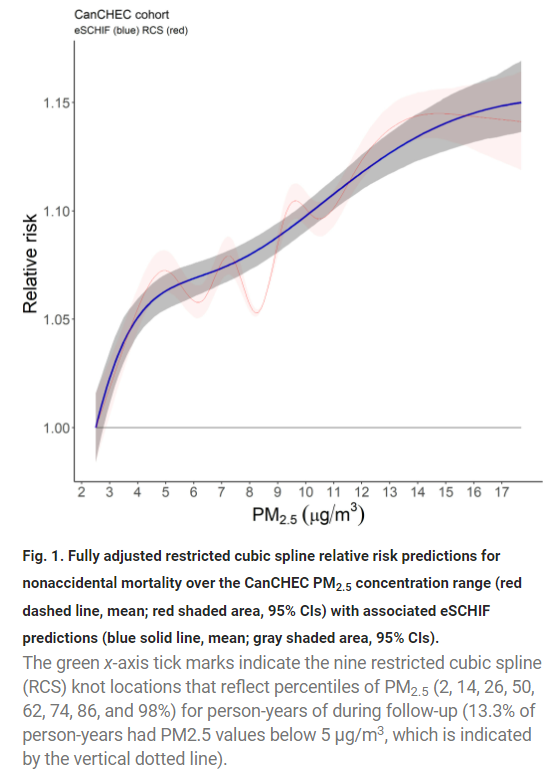
Even the prior WHOI guidelines of 10 ug/m^3 has a RR of 1.10. 5 ug/m^3 has one of like 1.05. AIR PURIFIERS EVERYWHERE - https://smartairfilters.com/en/
[ RR of 1.10 is not THAT horrible, you don’t have to go anal over this, but like, still, air purifiers and masks within reasonable limits - COVID made it easy to wear masks so do it]. I have tasted the air of University of British Columbia and that air is WAY cleaner than anywhere I’ve been other than Norway. Anyhow, reducing your air pollution exposure by ~70% is WAY easier than avoiding microplastics (even w/the ADHD constraint).
Air pollution is not completely disqualifying for longevity (Zhou Youguang - Wikipedia lived to 110) and many good people in the 20th century lived in the US/Europe when they were WAY more polluted [there isn’t an overabundance of supercentenarians from unpolluted regions [or is there?]]
…it’s not just PM2.5… NO2 and O3 affect the brain too.
Next, the researchers used EPA and other data to map air quality at each child’s residence, including levels of fine particulate matter (PM2.5), nitrogen dioxide (NO2) and ground-level ozone (O3). They then used advanced statistical tools to investigate how air pollution levels relate to changes in brain connectivity over time. In other words: are young brains developing differently when they are exposed to more pollution?
Greater exposure to PM2.5 was linked to relative increases in functional connectivity between regions, while more exposure to NO2 predicted relative decreases in connectedness. Exposure to higher levels of O3 was associated with greater connections within the brain’s cortex, but fewer connections between the cortex and other regions, such as the amygdala and hippocampus.