
Lead Biologist @OWLO | Preclinical R&D | Organoid & 3D Model Expert | Bridging Organoids & IVF Technologies | Life Sciences Consultant | Co-Founder editor & Bioventure Ninja @Bench2Ventures
9h •
Connect
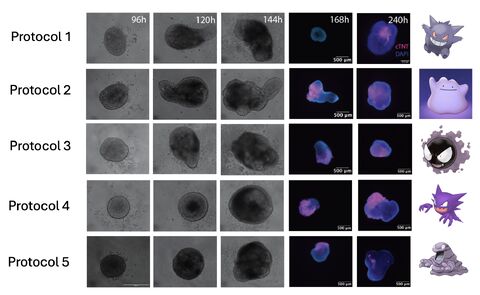
5 protocols. All generate “cardiac-like aggregates”. All express a Cardiac cell marker (cTnT). 
But look at them. 
Same stem cell line. Same differentiation goal. Same final markers.
Five completely different morphologies. Five completely different trajectories. Five completely different Pokémon. 
 Protocol 1 → Compact. Dense. Gengar energy.
 Protocol 2 → Shapeshifting blob. Pure Ditto.
 Protocol 3 → Round then chaotic. Classic Gastly.
 Protocol 4 → Aggressive expansion. Haunter vibes.
 Protocol 5 → Dense. Dark. Shapeless. Muk energy.
All cardiac marker positive at day 10.
All “cardiac-like aggregates” by the paper definition.
 But are they the same model?
Same markers ≠ same biology.
Same markers ≠ same drug response.
Same markers ≠ reproducible science.
This is why “organoids” tells you almost nothing without knowing which protocol, which morphology, which functional readout.
The field has 20+ published protocols. They all work. They all give you cTnT+ cells. But they don’t give you the same organoid. 
 Koala reviewed all 5 protocols. He has a favorite. He won’t tell you which one.
Which protocol would YOU trust for drug screening? 
#Organoids #StemCells #Reproducibility #DrugDiscovery #NAMs #Preclinical
6 comments6 comments
•
Like
Comment
Repost
Anichavezhi Devendran 2ndAnichavezhi Devendran • 2nd
8h
Follow
Spot On! and yes, this is why I love open-science discussions.